
Monty hall theory in decision making for options traders

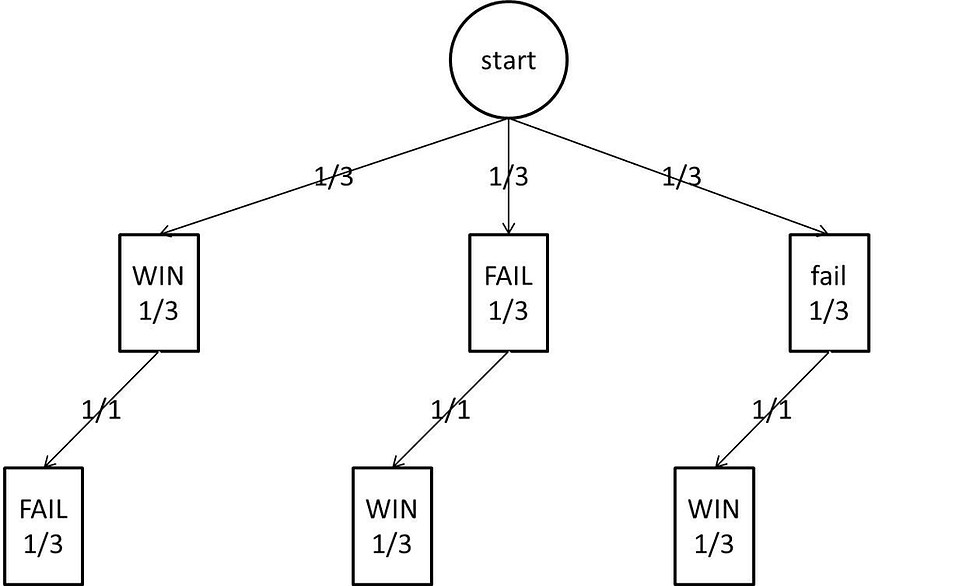


🎲 First, the Monty Hall idea (super quick recap)
You choose 1 door out of 3
Probability your choice is right = 1/3
Host opens one losing door
You’re offered a switch
If you switch, your probability jumps to 2/3
👉 The big insight:New information changes probability, even if nothing “physically” changed.
🧠 Core Monty Hall Principle (for traders)
Sticking with an initial decision is often inferior once partial information is revealed.
Markets constantly act like Monty:
They reveal some information
But not all
And you must decide: stick or switch
🧠 Monty Hall → Options Trading Mindset
1️⃣ Entry Bias vs Conditional Probability
Trader behavior
“I bought CE because EMA crossover looked strong”
“I’ll stick with it”
Monty Hall thinking
That setup had X% probability at entry
After 5–10 minutes, market revealed info
IV changed
OI shifted
Spot stalled or rejected
Probabilities are no longer the same
👉 Not switching = ignoring conditional probability
2️⃣ Options Example (CE vs PE switch)
Initial state
NIFTY at 22,000
You buy ATM CE
Odds:
CE success = 35%
PE success = 65% (but you picked CE)
Market reveals
Heavy CE OI build-up
No follow-through
PE OI unwinding
Delta drops, IV contracts
This is Monty opening a door 🚪
Now probabilities might be:
CE success = 20%
PE success = 60%
No-trade = 20%
👉 Rational Monty move: switch or exit
3️⃣ “Holding & Hoping” is the Monty Hall Trap
Many traders:
Enter with logic
Ignore new info
Hold because:
“Already paid premium”
“SL not hit yet”
That’s equivalent to:
“I picked Door 1, so it must be right”
Markets don’t reward loyalty.They reward updating beliefs.
🔁 Monty Hall Framework for Options Decision-Making
Step-by-step mental checklist
1. Initial probability
Why did I enter this option?
What edge did I assume?
2. Market reveals information
Spot behavior
OI shift
IV expansion / crush
Delta decay
Time decay acceleration
3. Conditional probability updateAsk:
“Given this info, would I enter this trade now?”
❌ If no → exit or switch✅ If yes → hold
📊 Strategy-Level Applications
🔹 A. CE → PE Switching Strategy
Enter CE on signal
If confirmation fails within N candles:
Exit CE
Enter PE or stay flat
This mirrors Monty’s switch advantage.
🔹 B. ATM → OTM / Hedge Switching
Enter ATM expecting momentum
Market stalls
Switch to:
OTM debit spread
Calendar
Or hedged short premium
🔹 C. Volatility Monty Hall
You bought option for IV expansion
IV doesn’t expand but time passes
Probabilities shift against long premium
👉 Switch from directional to neutral/short vol
🧪 Monte Carlo + Monty (Quant Angle — your territory)
In backtests:
Track post-entry conditional outcomes
Compare:
Hold till SL
Exit when probability degrades
Switch direction when opposite signal strengthens
You’ll usually see:
Switching early reduces drawdown and tail losses
This is classic Monty behavior playing out statistically.
⚠️ What Monty Hall is NOT saying
❌ Switch randomly❌ Overtrade❌ Flip direction every candle
It says:
Switch ONLY when the market reveals asymmetric information
Comments